MY TREK IN NEPAL’S GLORIOUSLY REMOTE, TOURIST-FREE SPOTS
THE HIMALAYAS ARE CHANGING BUT THERE ARE STILL PLACES THAT TOURISM AND TARMAC HAVEN’T YET REACHED. CHIEF TRAVEL WRITER CHRIS HASLAM GOES EXPLORING
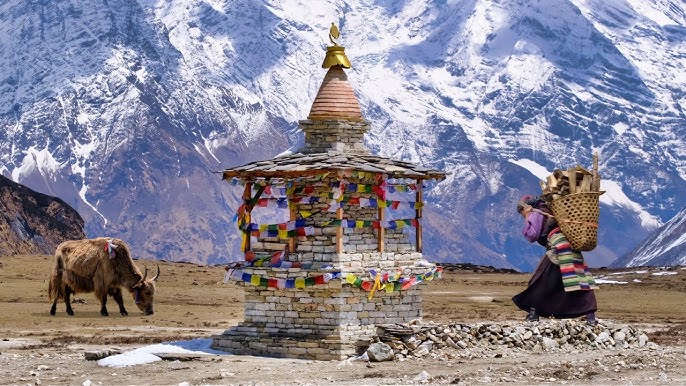
My trek in Nepal’s gloriously remote, tourist-free spots
Last night I camped outside Shanti Punn’s farmhouse, 9,000-odd feet up in the Himalayan foothills of Gandaki province. Punn is a typical member of the Magar community of Nepal — tough and pragmatic but blessed with an aesthetic sensibility. As the starlight faded early this morning I watched her emerge from her house, stand on her terrace and spend ten silent minutes absorbing the view.
I’m sitting on that terrace now, drinking masala chai and waiting for the sun to warm my frozen bones. To my left are the 23,000ft-plus peaks of four Annapurnas, as well as Hiunchuli, Gangapurna and Machapuchare — jagged and dazzling white, like teeth in the Earth’s lower jaw. Beneath them is the cloud-bound valley of the Modi River and, up to my right, an infinity of ridges where frostbitten chir pines twinkle.
In front, beyond a cascade of marigolds and over a stone wall where a flock of rosefinches are hassling Punn’s cat, I watch the silver threads of ancient footpaths converge, diverge then vanish into the cloud below. The Magar arrived here on foot from Tibet in the 12th century, and since then shanks’s pony has remained the only way to travel — but that’s changing fast. Cars are invading the Himalayas.

The pace of progress in Nepal is as breathtaking as the views. As recently as 2015, getting from the city of Pokhara to Punn’s hillside farm was a two-day trek. Then they built a road and now the journey takes just two hours. There’s a road up the Modi Valley too; it has reduced the first day of the 23-mile Annapurna Base Camp trek from a six-hour walk to a 45-minute drive.
In the Myagdi and Mustang districts of Gandaki province more than 60 per cent of the 145-mile Annapurna Circuit has been affected by road construction. And while there are no plans yet to build a road to Everest Base Camp a new track from Phaplu to Chaurikharka, a few miles short of Lukla airport, means that you no longer have to fly to the start of Nepal’s busiest trek.
Until 2024 Dolpo, west of Mustang, and neighbouring Humla were the only regions inaccessible to cars, but they are now connected. In 2018 it was reported that there were 83,000 earthmovers working in Nepal, operated by the so-called bulldozer mafia: shrewd local businessmen who got elected on the promise of new roads then awarded government contracts to their own companies.

The speed with which the graders are moving and the scale of the environmental destruction wrought by that advance are worrying Nepal’s trekking industry. So the explorer and guide Pawan Tuladhar and his friend Prabal Thapa, an architect and social anthropologist, have travelled to this quiet corner of Gandaki in search of the places that tarmac and tourism have yet to reach. I’m just tagging along, slightly embarrassed by the kit I’ve picked for this January stroll.
I’m wearing Smartwool thermals, Fjallraven technical hiking trousers, a Deerhunter outer shell and Alt-Berg mountain boots. Our local guide, Pridim, is wearing polyester trousers, knock-off trainers and an anorak that soaks up water when the snow turns to freezing rain. Every now and then he takes it off, wrings it out, grins and puts it back on. It’s no surprise that Magars are a major part of the British Army’s Brigade of Gurkhas.
This isn’t extreme hiking. The highest we go on this recce is 10,000ft, but the scenery is way too big for a western mind. When the clouds part the Himalayas smack me in the face — so inconceivably massive that I feel like an overdressed ant on the pavement of a frozen Manhattan. The locals, I notice, are almost as awestruck. Women stand in fields with their hands on their hips, staring. A pair of schoolboys sit on a boulder, gawping. A hunter points his 19th-century shotgun at a white plume on the south face of Dhaulagiri, 30 miles away, and says “himapahiro” — avalanche.

In one village we’re dragged into a house for tea — a common occurrence in a land where the Atithi Devo Bhava tradition declares that the guest is god. As her mother puts the kettle on the fire Samjhana Adikhari explains what difference the roads have made. “Before we were remote, forgotten,” she says. “Now we will be connected to the nation. Giving us a road will be like giving a sick man oxygen.”